Afternoon tea and high tea: what is the difference?
One was a dainty stopgap for the rich. The other was the main meal of a working day.
Afternoon tea is a light snack of tea, sandwiches and cake, taken in the middle of the afternoon to bridge a long gap before dinner. High tea was a full, hot meal with strong tea, eaten at the end of the working day. So the name that sounds grander belonged, in its traditional sense, to the plainer table.
If that seems the wrong way round, blame modern hotel menus, which sometimes use "high tea" for what the British would call afternoon tea. Here is the difference at a glance.
| Afternoon tea | High tea | |
|---|---|---|
| Who it began with | Wealthy households | Working households |
| When | Around four or five o'clock | Late afternoon or early evening, after work |
| Its job | A stopgap before a late dinner | The main meal of the day |
| The food | Bread and butter, dainty sandwiches, scones, cakes | Hot food, meat or fish, bread, followed by something sweet |
| Where | Often the drawing room, at a low table | The family table |
The Duchess and her long afternoon
The story everybody tells involves Anna Maria, wife of the seventh Duke of Bedford. Dinner in fashionable houses had drifted later, and she grew hungry in the gap. She began taking tea with something to eat in the middle of the afternoon, then invited friends along, and it became a social occasion.
Sources do not agree on the details. Historic UK puts it at 1840 with dinner at eight, while the UK Tea and Infusions Association says 1841 with dinner at around seven, and notes that it was "tradition" that credits her. The association also points out that the ladies' tea parties of the 17th century came first. So the Duchess may be better understood as someone who gave an existing habit a fixed hour and a fashionable name.
The custom took time to spread. By the 1880s, says Historic UK, society women would change into long gowns, gloves and hats for tea in the drawing room between four and five. The Food Timeline quotes a Mrs Beeton edition of 1879, which describes a small table with a tea service, rolled bread and butter, biscuits and cake. That is much closer to a snack than most of today's three-tiered stands.
Where high tea came from
High tea grew out of a change in how people worked. When most of the population worked on the land, the main meal was usually eaten at midday with a light supper later. The UKTIA explains that long shifts in factories and mines made a hot midday meal much less convenient, and that it did not suit growing numbers of schoolchildren either. So the main meal moved to the end of the day, and it came with strong tea.
The food was whatever a household could manage. A definition from The Cambridge Social History of Britain, quoted on Wikipedia, is a meal of bread, butter and tea extended with some fish or meat cooked in a frying pan. Grander versions existed too, and it was never quite as neat as a class label suggests. Food writers have described spreads with pies, salmon, trifle and several cakes.
As for the name, the usual explanation is the height of the table. High tea was eaten at the dining table, while afternoon tea was served on low tables in the drawing room. It is a tidy account, and we would not swear to it, but the Food Timeline and many others repeat it, and no better one has come along.
Tea, dinner and supper today
The word has lasted. In much of the North of England, Scotland, Wales and parts of Northern Ireland, plenty of people still call the evening meal "tea", and the midday meal "dinner". If someone in Leeds asks what you are having for your tea, they probably do not mean scones.
And a cream tea?
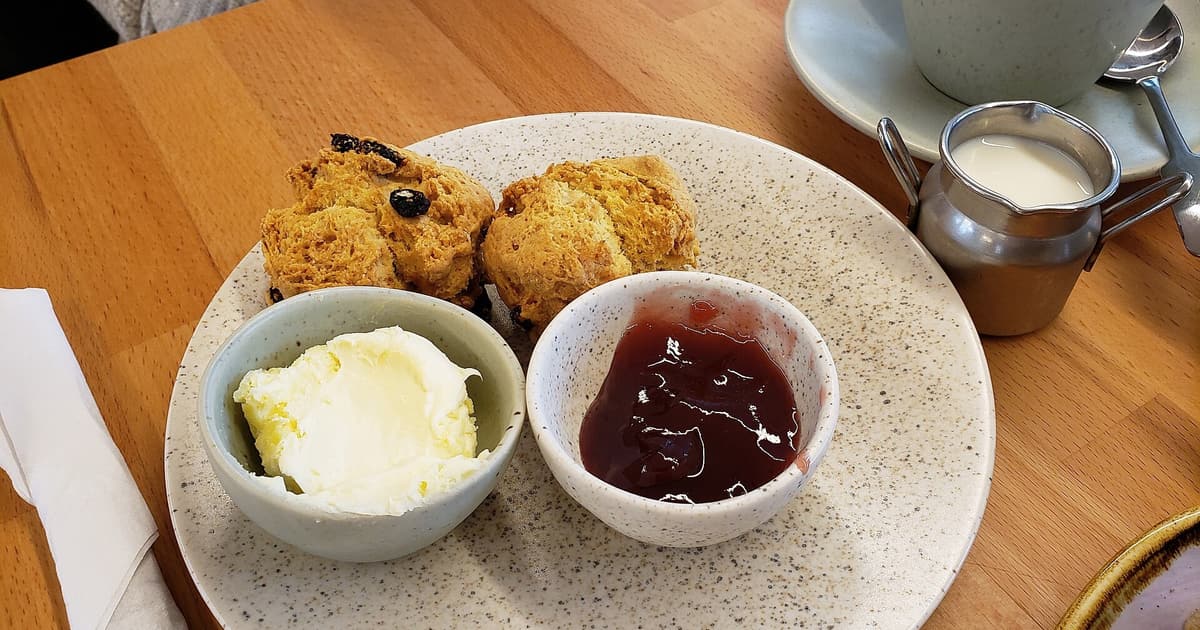
A cream tea is a simpler thing again: scones with clotted cream and jam, and a pot of tea. It is best known from the West Country, and the counties there each claim the best. The argument that lasts is about the order. Historic UK, based in Devon and making no secret of its bias, says cream first. Cornwall is generally said to put the jam on first. You will not need to settle this before eating one.
How tea got to the table: a short ledger
| Date | What happened |
|---|---|
| 1658 | A London newspaper carries the earliest known British advert for tea, sold at a coffee house. |
| 1660s | Catherine of Braganza, wife of Charles II, makes it fashionable at court. |
| 1664 | The East India Company places its first order, for 100lbs of China tea. |
| 1689 | Tax on tea moves from the brewed liquid to the leaf, and the quality of coffee-house tea improves. |
| About 1840 | The Duchess of Bedford's afternoon habit takes hold. |
| 1880s | Tea rooms and tea shops become fashionable, giving women a respectable place to meet without a male escort. |
| 1952 | Tea rationing ends in October, seven years after the war. |
| 1964 | Tea duties are finally abolished. |
Dates from the UKTIA's history of tea and social history pages.
Making a modest one at home
You do not need a three-tiered stand. A pot of good black tea, some thin bread and butter with cucumber, and one cake would have satisfied the Duchess perfectly well. Choose a tea that can stand up to the food, brew it for the right time with the help of our brewing dials, and make sure the tin it came from has been properly looked after. A first flush Darjeeling is a nice change later on, once the sandwiches are gone. If you are serving guests who are pregnant or watching their intake, our page on caffeine in tea may be useful, and a pot of herbal infusion alongside costs little extra.